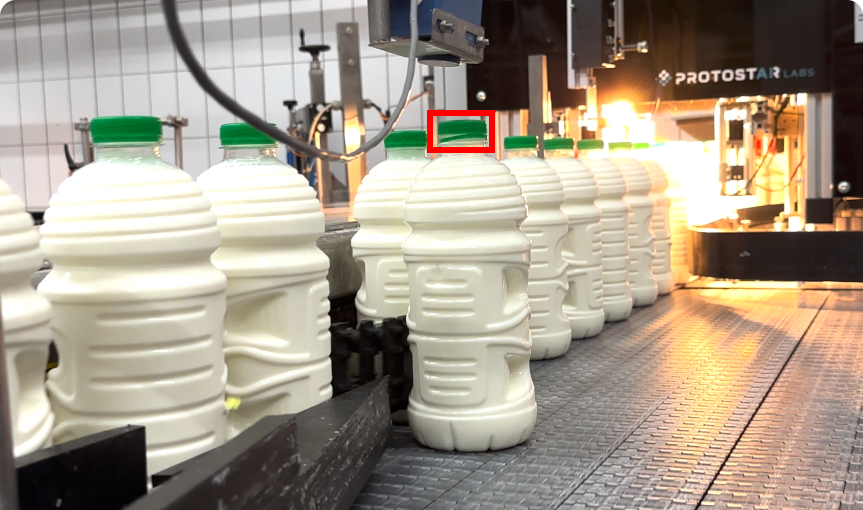
Overview
Production defects are a common problem in the food and beverage industry, but most of the issues that arise can be fixed using modern solutions such as machine learning and computer vision. Protostar Vision Box combines machine learning with on-board processing and direct integration into existing production lines to allow an immediate increase in production efficiency and worker satisfaction during which we are also reducing production costs and the rate of product returns. Machine learning allows us to track even the smallest imperfections if the environment demands it while keeping the false positive rate under 0.01%.
Goals
The goal of the project was to develop a system that will detect defects on five different bottle types, all of which can come in three different colors. Because of the large throughput rate, the error rate had to be minimal, and the latency plus inference time had to be under 100 ms. The developed system also had to be integrated into an existing production line that already had a bottle ejection system integrated into it.
Solution
The Protostar Vision Box contains two industrial cameras mounted on each side to allow a near 360-degree view of the bottle. On top of that, there are six optical sensors mounted at various points that keep track of the bottle as it passes through the Vision Box. Sensors trigger the cameras, after which the PC grabs the images and processes them using a deep learning model inspired by YOLO architecture. After the processing is done and the algorithm finds the bottle as bad, the number of bottles is sent to the PLC, which turns on the ejection when the bottle reaches a certain point. There is also a photoelectric throughbeam sensor mounted that controls if the liquid level is above minimal.
Results
- Achieved a model accuracy of 99.7% with a false positive rate of under 0.01%
- 10 million bottles processed without any hardware or software errors